
If you have ever asked yourself "How do I start my CA journey in Pakistan?", the answer begins with three letters: PRC. The CA PRC level is the official entry point into ICAP's Chartered Accountancy program — and understanding it fully could be the decision that shapes your entire professional career.
This guide walks you through everything: what the PRC level is, who can apply, what subjects you will study, how difficult it really is, and what comes next after you pass. Whether you are fresh out of intermediate or exploring accounting career pathways in Pakistan, this article is your complete roadmap.
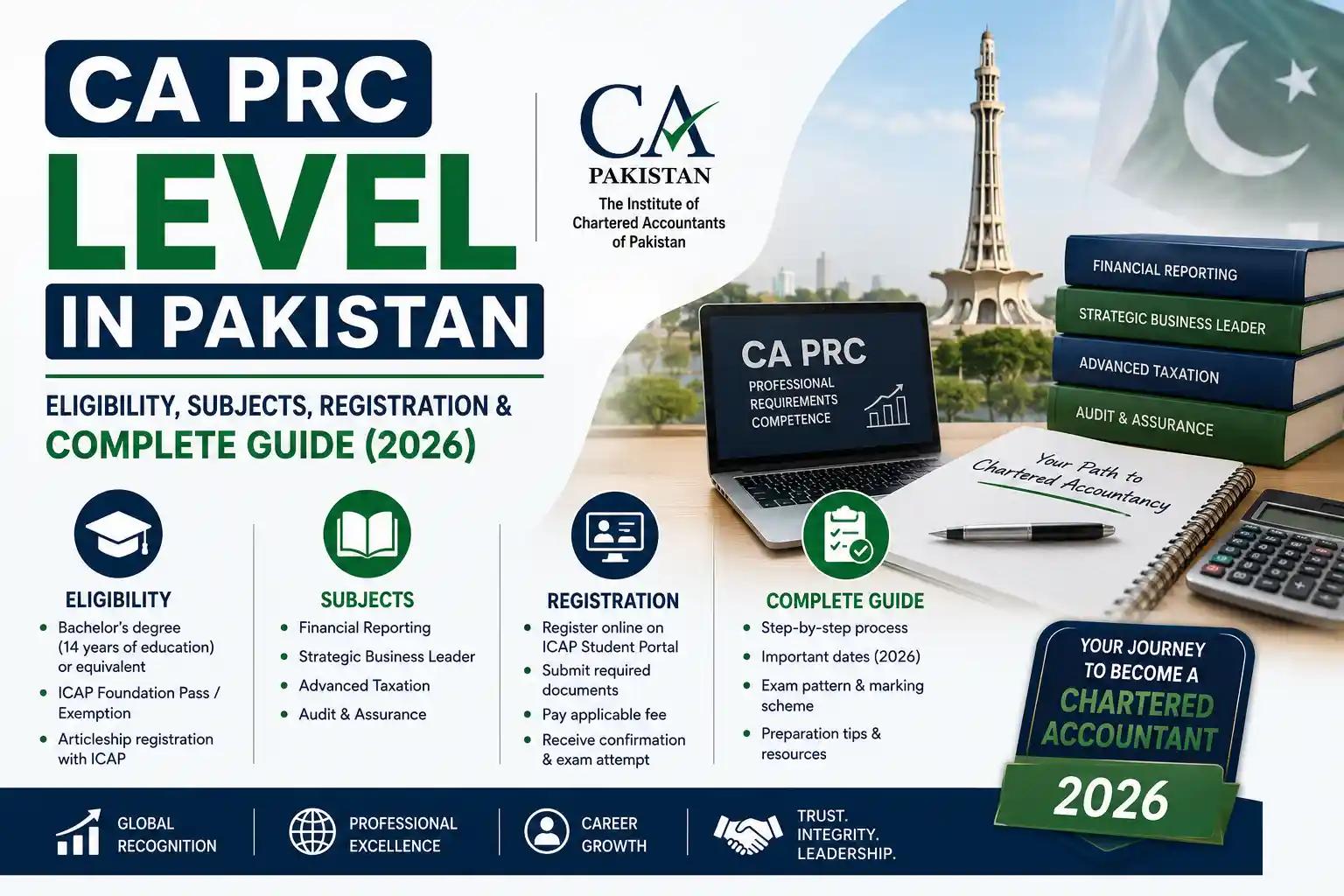
PRC (Preliminary Relevant Competencies) is the foundation level of the ICAP Chartered Accountancy (CA) qualification in Pakistan. It introduces students to accounting principles, business communication, economics, and quantitative methods, preparing them for the CAF level and future accounting careers in Pakistan and internationally.
What Is PRC Level in CA? (ICAP CA Structure Explained)
The PRC (Preliminary Relevant Competencies) Level is the first stage of the Chartered Accountancy (CA) qualification offered by the Institute of Chartered Accountants of Pakistan (ICAP). It is designed to build a strong foundation in accounting, business, communication, economics, and quantitative skills before students progress to higher levels of the CA program.
The CA PRC Level in Pakistan helps students develop the fundamental knowledge and professional mindset required for success in the ICAP qualification. Whether you have completed Matric, Intermediate, A-Levels, or an equivalent qualification, PRC serves as the starting point for your journey toward becoming a Chartered Accountant (CA).
You can think of the PRC Level as the foundation of your professional accounting career. Just as a strong foundation supports a building, the PRC stage prepares students for advanced studies in the Certificate in Accounting and Finance (CAF) and the later stages of the CA qualification.
CA PRC Level Subjects (Explained)
The CA PRC Level is designed to build a strong foundation in accounting, business, economics, and analytical thinking. These core subjects prepare students for the Certificate in Accounting and Finance (CAF) stage while developing the essential knowledge and practical skills required for a successful career in accounting and finance.
Introduction to Accounting
Introduction to Business
Economics Basics
Quantitative Methods
Each subject focuses on practical concepts, problem-solving, and business fundamentals, helping students confidently progress through the ICAP Chartered Accountancy (CA) qualification and prepare for professional opportunities in Pakistan and international accounting environments.
Introduction to Accounting In CA PRC Level
Introduction to Accounting is one of the most important subjects in the CA PRC Level because it forms the foundation of the entire Chartered Accountancy (CA) qualification. Before studying advanced subjects such as auditing, taxation, financial reporting, or corporate finance, every CA student must first understand the basic principles of accounting.
What is Accounting?
Accounting is the systematic process of recording, classifying, summarizing, and interpreting the financial transactions of a business or organization. In simple terms, accounting helps businesses track their income, expenses, assets, liabilities, and overall financial performance.
From small businesses to multinational companies, accounting plays a vital role in making financial decisions, preparing reports, complying with tax regulations, and maintaining transparency.
Why accounting is important:
Helps businesses measure profits and losses.
Supports informed financial and business decisions.
Ensures compliance with tax and financial reporting requirements.
Builds the foundation for advanced CA subjects such as Audit, Taxation, Financial Reporting, and Corporate Finance.
Provides reliable financial information for business owners, investors, lenders, and regulators.
A strong understanding of accounting is essential for every aspiring Chartered Accountant (CA). That's why ICAP introduces this subject at the beginning of the CA PRC Level, preparing students for the more advanced stages of the qualification.
Basic Accounting Concepts In CA PRC Level
Debit and Credit: The Foundation of Double-Entry Accounting
Debit and Credit are the two fundamental components of the double-entry accounting system, which is used by businesses worldwide to record financial transactions accurately. Every transaction affects at least two accounts, ensuring that the accounting records remain balanced and reliable.
Debit (Dr): Recorded on the left side of an account. It generally increases assets and expenses, while decreasing liabilities, equity, or income.
Credit (Cr): Recorded on the right side of an account. It generally increases liabilities, owner's equity, and income, while decreasing assets and expenses.
Golden Rule of Debit and Credit:
Real Accounts: Debit what comes in, Credit what goes out.
Personal Accounts: Debit the receiver, Credit the giver.
Nominal Accounts: Debit all expenses and losses, Credit all incomes and gains.
Example:
If a business purchases a computer for PKR 50,000 in cash:
Assets, Liabilities, and Capital (Accounting Equation)
The Accounting Equation is one of the most important concepts in the CA PRC Level and serves as the foundation of financial accounting.
Accounting Equation:
Assets = Liabilities + Owner's Capital (Equity)
Assets
Assets are the resources a business owns or controls that provide future economic benefits.
Examples: Cash, Bank Balance, Inventory, Machinery, Land, Buildings, and Accounts Receivable.
Liabilities
Liabilities represent the financial obligations or debts a business owes to individuals or organizations.
Examples: Bank Loans, Trade Payables, Taxes Payable, and Other Outstanding Expenses.
Capital (Owner's Equity)
Capital, also known as Owner's Equity, represents the owner's investment in the business after deducting all liabilities from total assets.
A correctly maintained accounting system always keeps this equation balanced. If the equation does not balance, it indicates an error in recording financial transactions that must be identified and corrected.
Revenue and Expenses in Accounting
Revenue and Expenses are the two key elements used to determine whether a business earns a profit or incurs a loss.
Revenue
Revenue is the income generated from a company's primary business activities, such as selling products or providing services.
Examples: Sales Revenue, Service Income, Consultancy Fees, and Commission Income.
Expenses
Expenses are the costs incurred to operate the business and generate revenue.
Examples: Salaries, Rent, Utilities, Marketing Expenses, Office Supplies, and Depreciation.
Profit and Loss
Profit: Revenue exceeds Expenses.
Loss: Expenses exceed Revenue.
Understanding the relationship between revenue and expenses enables students to prepare and interpret the Income Statement, one of the most important financial statements studied in the CA PRC Level and used by businesses around the world.
Introduction to Business(CA PRC Level)
Every Chartered Accountant (CA) works with businesses—whether by preparing financial statements, conducting audits, managing taxes, or providing financial advice. That's why understanding business fundamentals is an essential part of the CA PRC Level syllabus. Before learning advanced accounting and finance concepts, students must first understand how businesses operate and create value.
What Is Business?(Business Basics)
A business is an organized economic activity in which individuals or organizations produce, buy, or sell goods and services to earn a profit while creating value for customers and society. Businesses play a vital role in economic development by generating employment, encouraging innovation, and contributing to national growth.
In simple terms, a business is any activity carried out to provide products or services in exchange for money or other forms of value.
Purpose of Business:
Every business operates with specific objectives that contribute to its long-term success and economic growth.
Generate Profit: Profit enables a business to grow, invest, and remain financially sustainable.
Satisfy Customers: Businesses succeed by solving customer problems and meeting market needs through quality products and services.
Create Employment: Businesses provide job opportunities, improve livelihoods, and support economic stability.
Support the Economy: They contribute to GDP, pay taxes, strengthen supply chains, and promote national development.
Encourage Innovation: Businesses introduce new ideas, technologies, and services that improve productivity and quality of life.
Understanding these business fundamentals helps CA PRC students interpret financial information, evaluate business performance, and apply accounting knowledge in real-world business environments. This knowledge also prepares students for advanced subjects in the ICAP Chartered Accountancy (CA) qualification and builds skills that are valuable in Pakistan and international business environments.
Types of Business In CA PRC Level
ICAP's PRC syllabus requires students to understand how businesses are legally structured. Each structure has different implications for accounting treatment, taxation, and liability.
Sole Proprietorship
A sole proprietorship is the simplest form of business, owned and managed by a single individual. It is one of the most common business structures in Pakistan, especially for small retail shops, pharmacies, freelancers, and local service providers. Since the owner and the business are legally the same entity, the owner is responsible for all business decisions, profits, and liabilities.
Key Features of a Sole Proprietorship:
Owned and controlled by one person.
The owner receives all profits and bears all losses.
Unlimited liability, meaning personal assets may be used to settle business debts.
Easy and inexpensive to establish.
No separate legal identity from the owner.
Why It Matters in CA PRC Level
Understanding a sole proprietorship helps students learn the basics of business ownership, accounting records, taxation, and financial reporting, forming a strong foundation for advanced accounting topics.
Partnership
A partnership is a business owned by two or more individuals who agree to share capital, profits, responsibilities, and business management. Partnerships are widely used by accounting firms, law firms, medical practices, and professional service businesses in Pakistan.
Key Features of a Partnership:
Formed by two or more partners.
Operates under a Partnership Agreement (Partnership Deed).
Partners share profits and losses according to the agreed ratio.
Partners jointly participate in business decisions.
Generally has unlimited liability unless otherwise provided by law.
Why It Matters in CA PRC Level
Partnership accounting introduces concepts such as capital accounts, profit-sharing ratios, drawings, and partnership financial statements, which are essential topics in the Chartered Accountancy curriculum.
Companies
A company (corporation) is a separate legal entity that exists independently from its owners (shareholders). In Pakistan, companies are incorporated under the Companies Act, 2017 and regulated by the Securities and Exchange Commission of Pakistan (SECP). Companies are generally preferred by medium and large businesses because they offer greater legal protection, easier access to investment, and long-term growth opportunities.
Key Features of a Company:
Separate legal identity from its owners.
Limited liability for shareholders.
Ownership is divided into shares.
Managed by a Board of Directors.
Can raise capital from investors and financial institutions.
Subject to legal, financial, and regulatory compliance requirements.
Types in Pakistan:
Private Limited Company (Pvt. Ltd.) — Restricted to 50 shareholders, cannot offer shares to the general public
Public Limited Company (Ltd.) — Can offer shares publicly; listed companies trade on the Pakistan Stock Exchange (PSX)
Why It Matters in CA PRC Level
Understanding company structures helps students learn corporate accounting, financial reporting, auditing, taxation, and corporate governance. These concepts are fundamental for progressing through the ICAP Chartered Accountancy (CA) qualification and are widely applied in both Pakistan and international business environments.
Economics Basics(CA PRC Level)
Economics is one of the core subjects in the CA PRC Level because it helps students understand how individuals, businesses, and markets make financial decisions. A Chartered Accountant (CA) uses economic principles to analyze business performance, evaluate investments, understand pricing strategies, and support informed financial decision-making.
The Economics Basics section of the PRC syllabus introduces students to essential concepts such as supply and demand, market equilibrium, pricing, and resource allocation. These concepts form the foundation for understanding how businesses operate in Pakistan's economy while also providing knowledge that is relevant in international markets.
Understanding the basic Concept of Supply and Demand
Basic Concept
Supply and demand is one of the most important concepts in economics and forms the basis of every competitive market. It explains how the prices of goods and services are determined, why shortages and surpluses occur, and how businesses decide what products to produce and sell.
Demand is the quantity of a product or service that consumers are willing and able to buy at different price levels. According to the Law of Demand, demand generally decreases as prices increase, while lower prices usually increase demand.
Supply is the quantity of a product or service that producers are willing and able to offer for sale at different price levels. According to the Law of Supply, producers generally supply more products when prices rise because higher prices can increase profitability.
Market Equilibrium occurs when the quantity demanded equals the quantity supplied. At this point, the market reaches a balanced price where there is neither a shortage nor a surplus.
Understanding these principles helps future Chartered Accountants analyze business performance, pricing strategies, budgeting, and financial planning across different industries.
Real World Example OF Supply And Demand
Example 1: Wheat Market in Pakistan
If floods or unfavorable weather reduce wheat production, the supply of wheat decreases while demand remains relatively stable. As a result, wheat prices increase due to limited availability. This is a practical example of the Law of Supply and Demand in Pakistan.
Example 2: Smartphone Industry
When a newly launched smartphone has limited stock but receives high customer demand, its market price often remains high. As production increases and supply improves, prices gradually stabilize or decline.
Example 3: Chartered Accountants in Pakistan
The demand for qualified Chartered Accountants (CAs) in Pakistan continues to grow across audit firms, banks, multinational companies, and the corporate sector. Since the supply of qualified professionals is relatively limited, Chartered Accountants often enjoy strong career prospects and competitive salaries. This demonstrates how supply and demand influence labor markets as well as product markets.
A clear understanding of economics enables CA PRC students to interpret market trends, evaluate business decisions, and understand the economic environment in which organizations operate. These skills are valuable not only in Pakistan but also in international accounting and finance careers.
Quantitative Methods(CA PRC Level)
Quantitative Methods is one of the core subjects in the CA PRC Level. It equips students with the mathematical and analytical skills needed to solve accounting, finance, taxation, and business problems. Rather than focusing on advanced mathematics, this subject emphasizes practical calculations that every future Chartered Accountant (CA) uses throughout their professional career.
Basic Matheamatical Skills For CA Student
Many students hesitate to pursue Chartered Accountancy (CA) because they believe it requires advanced mathematics. In reality, the CA PRC Level focuses on practical numerical skills rather than complex mathematical theories. Students learn how to perform everyday business calculations that are essential in accounting, finance, taxation, and auditing.
The objective is to develop confidence in solving financial problems accurately using simple mathematical techniques that are applied throughout the ICAP qualification.
Ratios
A ratio is a comparison of two quantities expressed in the form A:B or as a fraction. In accounting and finance, ratios are used to analyze a business's financial health, efficiency, and profitability.
Why ratios matter for CA students: Ratios transform raw financial data into meaningful insights. An investor looking at a Balance Sheet does not just want numbers — they want to know if the business is healthy.
Key examples at PRC level:
Current Ratio = Current Assets ÷ Current Liabilities If a business has Rs. 200,000 in current assets and Rs. 100,000 in current liabilities, the current ratio is 2:1 — meaning it can comfortably cover short-term debts. A ratio below 1 signals financial stress.
Debt-to-Equity Ratio = Total Debt ÷ Total Equity Tells you how much of the business is financed by borrowing versus the owner's own money.
Profit Ratio = Net Profit ÷ Revenue × 100 Expresses profit as a percentage of sales.
Ratios become even more powerful when compared across time periods (is the business improving?) or against industry benchmarks (how does this business compare to its competitors?). At PRC level, the goal is to understand what ratios are and how to calculate them — the deeper analysis comes at CAF and CFAP.
Percentages
Percentages are arguably the single most-used mathematical tool in all of accounting, taxation, and finance. Every CA student must be completely fluent in percentage calculations.
Core percentage calculations:
Profit Percentage on Cost: Formula: (Profit ÷ Cost Price) × 100 Example: A product costs Rs. 400 and sells for Rs. 500. Profit = Rs. 100. Profit % = (100 ÷ 400) × 100 = 25%
Percentage Change: Formula: ((New Value − Old Value) ÷ Old Value) × 100 Example: Revenue was Rs. 1,000,000 last year and Rs. 1,200,000 this year. % Change = ((200,000) ÷ 1,000,000) × 100 = 20% increase
Tax Calculation: If income tax rate is 15% on taxable income of Rs. 500,000: Tax = 500,000 × 15% = Rs. 75,000
Discount Calculation: If a 10% discount is offered on a Rs. 2,000 product: Discount = 2,000 × 10% = Rs. 200 → Selling price = Rs. 1,800
These calculations appear constantly in financial accounting, cost accounting, and taxation — three subjects that dominate the later stages of the ICAP CA qualification.
Simple Financial Calculations
The CA PRC Level also introduces students to practical financial calculations that form the foundation of accounting and finance.
These include:
Simple Interest – Calculates interest earned or paid on the original principal amount.
Compound Interest – Explains how interest grows when earned on both the principal and accumulated interest.
Markup and Margin – Helps students understand pricing strategies and profitability.
Basic Algebra – Used to solve unknown values in accounting and financial calculations.
Average and Weighted Average – Important for inventory valuation, business analysis, and financial decision-making.
Mastering these quantitative skills enables students to perform accounting calculations confidently and prepares them for advanced topics in financial accounting, taxation, business finance, and corporate reporting. These concepts are valuable for careers in Pakistan's accounting profession while also providing mathematical skills that are applied in international accounting and finance practices.
CA PRC Level Duration in Pakistan
The CA PRC Level is the foundation stage of the ICAP Chartered Accountancy (CA) qualification. The time required to complete this stage depends on a student's preparation, study schedule, and examination performance.
Most students complete the PRC Level within 3 to 6 months, while others may take longer depending on their academic background and the number of examination attempts. After successfully passing the PRC Level, students become eligible to continue to the Certificate in Accounting and Finance (CAF) stage.
Building a strong foundation at the PRC level helps students perform better in the advanced stages of the CA qualification and prepares them for long-term success in accounting and finance.
Career Opportunities After CA PRC Level:
Although the CA PRC Level is an introductory stage and does not qualify students as professional accountants, it provides the knowledge and skills needed to progress toward a successful career in accounting and finance.
After completing the PRC Level and advancing through the ICAP qualification, students can pursue careers such as:
Chartered Accountant (CA)
Auditor
Tax Consultant
Financial Accountant
Financial Analyst
Corporate Finance Executive
Internal Auditor
Accounts Officer
Finance Manager
Chief Financial Officer (CFO)
Qualified Chartered Accountants are in demand across audit firms, multinational companies, banks, financial institutions, public sector organizations, and corporate businesses in Pakistan. In addition, the skills gained through the ICAP qualification are valued in many international markets, creating opportunities for professionals seeking global careers in accounting and finance.
Expert Guidance:
The PRC Level should never be treated as a hurdle to clear quickly. It is the foundation of the entire ICAP Chartered Accountancy qualification. A strong conceptual understanding at this stage can make advanced subjects such as Financial Reporting, Audit, Taxation, and Corporate Finance significantly easier. Students who prioritize learning over memorization are generally better prepared for professional challenges and long-term success in the accounting profession.
Frequently Asked Questions (FAQs)
Q1: What is PRC level in CA? PRC (Preliminary Relevant Competencies) is the foundation stage of the ICAP CA program in Pakistan. It covers financial accounting basics, business fundamentals, economics, and quantitative methods. It is the mandatory first step before entering the CAF stage.
Q2: Is PRC the first step of CA in Pakistan? Yes. PRC level is the first and entry-level stage of the ICAP CA qualification in Pakistan. All new CA students must register and pass PRC before moving forward.
Q3: How many levels are in ICAP CA? ICAP CA has four examination levels: PRC, CAF, CFAP, and MSA. These are completed alongside practical articleship training at an approved firm.
Q4: What is the passing criteria of PRC level? Students must achieve a minimum of 50% in each individual paper and meet the overall aggregate requirement set by ICAP for the attempt.
Q5: Can I do CA after matric or intermediate? You can start CA after completing intermediate (FSc, FA, I.Com, or equivalent). Matric alone is not sufficient — you need at least an intermediate-level qualification to register for PRC.
Q6: What subjects are in PRC level? PRC level covers: (1) Financial Accounting Fundamentals, (2) Business Basics including types of businesses and their purpose, (3) Economics Basics including supply and demand, and (4) Quantitative Methods covering ratios, percentages, and basic calculations.
Q7: How long does CA take in Pakistan? The full CA journey — from PRC registration to receiving ICAP membership — typically takes 5 to 6 years, depending on exam attempts and articleship completion.
Q8: Is CA better than ACCA in Pakistan? Both qualifications are highly respected. CA (ICAP) generally holds stronger weight for senior corporate roles within Pakistan. ACCA offers better international portability. The best choice depends on your career goals — and ICT Business School offers both programs to help you decide.
Conclusion: Your CA Journey Starts at PRC
The CA PRC level is not just an exam — it is the beginning of one of the most rewarding professional careers available in Pakistan. It introduces you to accounting basics, business structures, economics, and the quantitative thinking that underpins every great financial mind.
The PRC level is designed to build a foundation for the CA qualification — and with the right guidance, it is absolutely achievable for any motivated student.
Whether you are just out of intermediate, exploring accounting career pathways in Pakistan, or switching from another field, the path forward is clear: start with PRC, stay consistent, and build upward.
Ready to take the first step? Explore CA and all professional programs at ICT Business School — where experienced faculty, structured study plans, and a proven track record are waiting for you. Contact ICT Business School today and begin your Chartered Accountancy journey with confidence.
For more insights on professional qualifications, career pathways, and study strategies in Pakistan, visit the ICT Business School Blog.
School News
safklsjdlfkds Level in Pakistan: Eligibility, Subjects, Registration & Complete Guide (2026)
July 7, 2026

July 7, 20262 minBy Administration Office